
Good to Great
How do we move our writing from 'good' to 'great'?

Our small but perfectly formed online writing group have been working together for over a year. Initially, we were on the same short story writing course with City St George, London. When the ten weeks of sessions came to an end, part of that cohort - under the gentle leadership of Elisa - decided to continue to support one another by evaluating each other’s work.
Good writers know the basics. They have an idea, shape it into a story arc, develop the setting and characters. They show, don’t tell. They watch their spelling and grammar; when dialogue is included, it’s realistic and they don’t overdo the speech verbs. They remember that in short stories, every word has to earn its place and are creative with vocabulary. Stereotypes and cliches are off the table.
I think it’s fair to say that in the group we’re all ‘good’ writers; sometimes there are flashes of brilliance. Many in the group are consistently good. Some have incredible imaginations and vocabulary skills that, with development, give their stories potential to become very special. What does that development need to focus on? What does the ‘good’ need to work on to become ‘great’? What causes the shift from longlist to shortlist? How can you earn your place on lists for the big-name competitions: BBC, Bridport, MsLexia, et al?
Alongside others I’ve had some publishing success, yet I feel my writing has settled into a comfort zone and, as a consequence, risks stagnation. Which is why I am encouraged to read the quote that ‘developing writers often feel more uncertain over time, not less’ (Sommers & Saltz 2004). In our group we mentor one another when giving feedback; perhaps part of this journey of progress means a move towards a coaching model. Or, more realistically, a mix of both.
The question about moving from ‘good to great’ has to be worth thinking about, right? Asking it in the first place means we are making progress, ‘developing’ as writers. Hence this month we are individually considering our top three tips.
So, here are my thoughts on what is needed to move from a solid grade B to a shiny grade A.
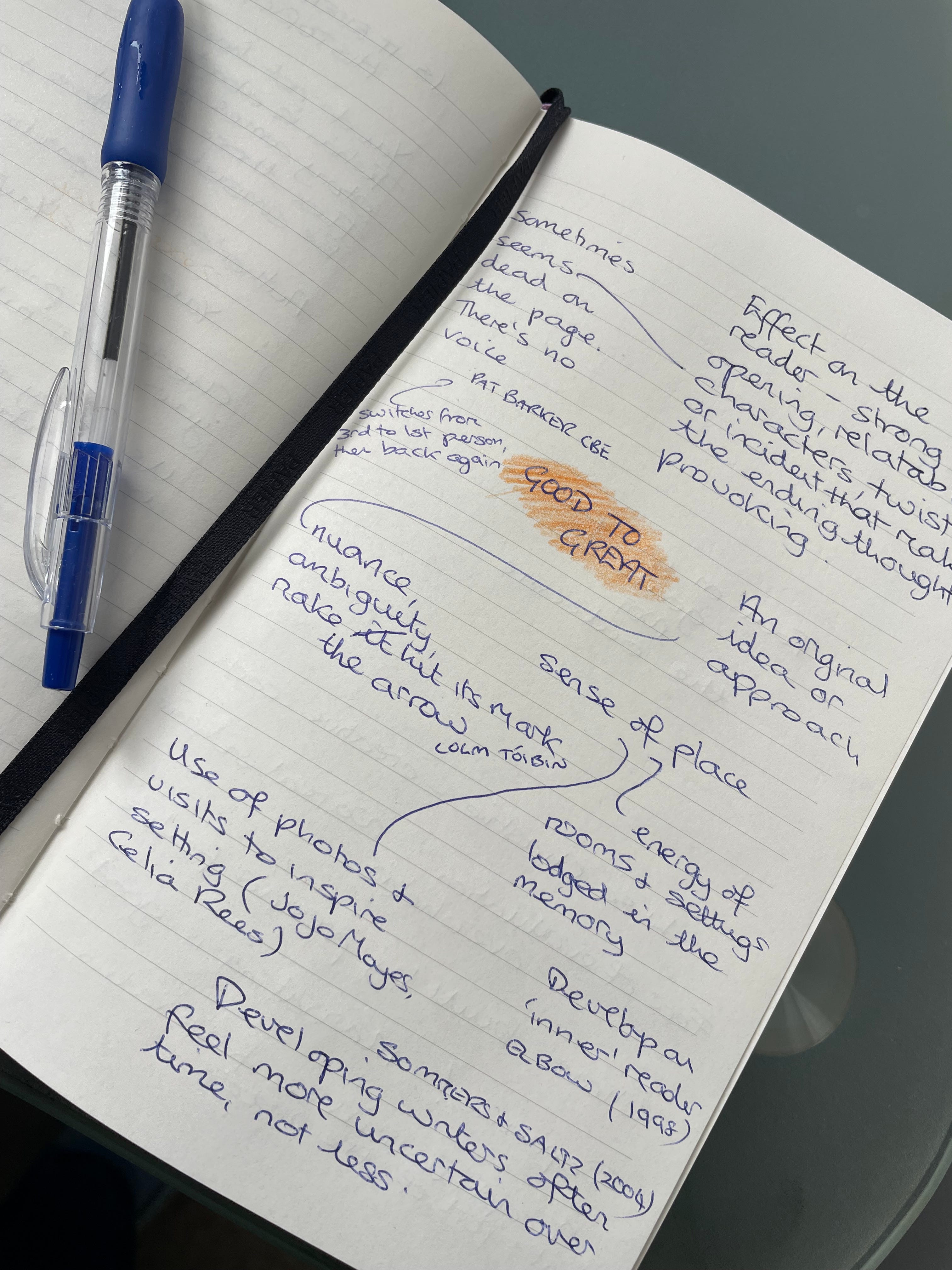
Effect on the reader
Well-known, successful authors such as David Nicholls and Jojo Moyes consider effect before they put pen to paper. How do I want the reader to feel when they read this? Do I want them to laugh, cry, feel nostalgia, curiosity, recognition? This applies at sentence, paragraph and chapter level, depending on your genre.
Academic research about writing adds to this by citing the importance of writers ‘developing an inner reader’ (Elbow, 1998). This is the ability to read your writing ‘at a distance’, in the shoes of the reader. Do you have strong, relatable characters with a clear voice? Pat Barker, CBE, suggests a trick for avoiding your character becoming dead on the page. When writing in the third person, do another draft in the first person, then switch back again to third. Does that help your character become less two dimensional?
Strong sense of place
This applies to small details as well as the bigger scene setting. Colm Tóibín talks about ‘nuance, ambiguity, make the arrow hit its mark.’ As writers we intuitively know when we’ve got this right; it’s that sentence we’re particularly proud of, the one that sticks in our memory and perhaps gets adapted for another piece. One that immediately springs to mind from my own writing is ‘cushions dented by deep conversations’ (‘Zest for Life’, published in the first edition of Lemon Pip magazine).
Stephen King in his book ‘On Writing’ says that ‘description begins in the writer’s imagination, but should flourish in the reader’s’ – a nod to my previous argument about the effect of your words on the reader.
In a Guardian article (28.3.26), Colm Tóibín refers to the energy of rooms and setting being ‘lodged’ in his memory. He might recall a bedroom from decades ago and combine it with a place he’s been recently. I’m intuitively drawn to this approach as it’s one I do all the time, never knowing it’s a recommended technique. Other writers use photos and research visits to inspire setting (Jojo Moyes, Celia Rees). I do these too. But perhaps not often enough?
But the hardest part of creating a strong sense of place, the skill that moves writing from good to great, has to be those two words at the start of this section. Nuance. Ambiguity.
An original idea or approach
I’ve saved the most challenging one for last. I once said to the tutor of a writing class ‘any idea I have has been used before’. Her reply? ‘Every idea has been used before. What makes your story different is the way that you tell it’.
This idea was liberating and gave me enough confidence to plough on with my writing. But, whenever I read entries by competition winners – or a remarkable short story elsewhere – I pause, hesitate, risk stopping altogether. How can I ever write as well as that?
And there we have it. Imposter syndrome. Do I have it in me to move from good to great? Or is Stephen King’s view the one to go with, ‘if you’re a good writer and want to be great … fuhgeddaboudit.’
I do know there’s room for improvement. I’ll let you know what the rest of the group come up with.
Enjoy this? Take a look at the last time I did a bit of naval gazing.
Thanks for sharing your learnings from your writing course! It's great that you've stayed in touch with your fellow students. Finding a writing group like that isn't easy!